


How Long to Fast During Each Phase of Your Cycle

Updated: May 4

If you've ever pushed through a longer fast and felt terrible, irritable, or completely depleted, there's a real reason for that.
One of the most common mistakes I see women make with fasting is treating every day of their cycle the same. They pick a fasting window, stick to it seven days a week, and then wonder why some days feel effortless and other days leave them exhausted, anxious, or ravenously hungry by 10am.
Here's what nobody told you: your hormones respond differently to fasting depending on where you are in your cycle. Fasting can be your hormones' best friend or their worst enemy. The difference is how and when you use it.
This is exactly why I created the Fasting Cycle in Fast Like A Girl.
What Is the Fasting Cycle?
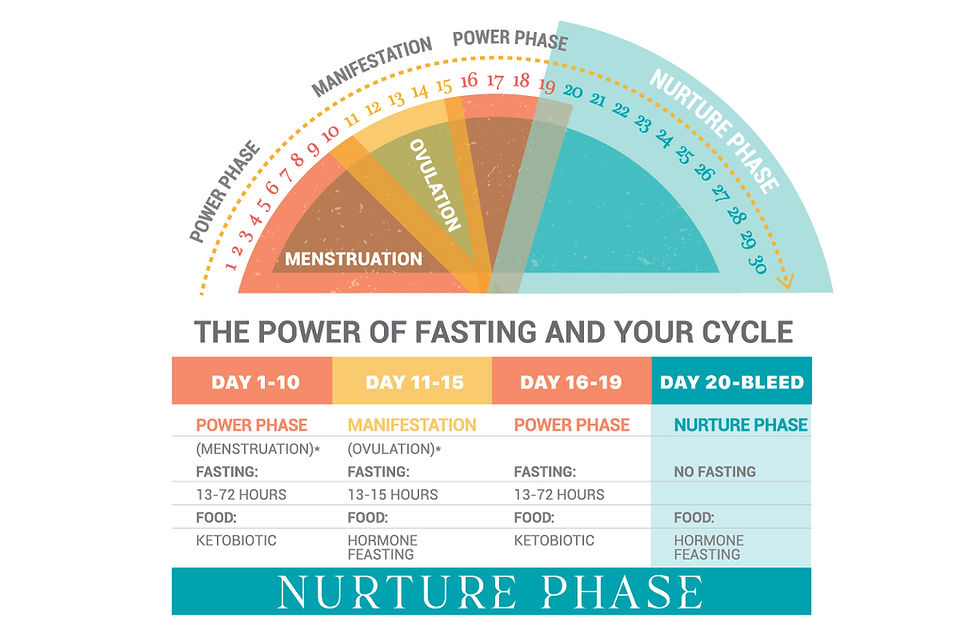
The Fasting Cycle breaks your menstrual cycle into four phases, each with its own hormonal environment and its own ideal fasting approach. Once you understand these phases, you stop fighting your body and start working with it.
Here's a quick look at how it maps out across a typical 28-day cycle:

Let's walk through each one.
Power Phase 1: Days 1–10
Fasting length: 13 to 72 hours

This phase begins on the first day of your period. It might seem counterintuitive to think of Day 1 as a power day, but it is. Your hormones are at their lowest point right now, and that's actually your advantage.
When sex hormones are low, your body tolerates fasting beautifully. There's no hormonal interference. This is the time in your cycle when longer fasts feel more natural, hunger feels more manageable, and your body can go deep into healing.
During Power Phase 1, your body is beginning to build estrogen. Estrogen loves a low-insulin environment. Fasting lowers insulin, which creates the exact conditions estrogen needs to thrive. This is why longer fasting windows during this phase can support not just weight loss and metabolic health, but hormonal balance as well.
If you've been wanting to experiment with a 24-hour fast, a 36-hour fast, or even a longer extended fast, this is the window to do it. Pair it with ketobiotic eating when you do break your fast: good fats, moderate protein, low carbohydrates.
What to know: The more aggressive you go with fasting during this phase, the more healing potential you unlock. Autophagy, cellular repair, ketosis. It all becomes available to you here.
Manifestation Phase: Days 11–15
Fasting length: 13–15 hours maximum

This is ovulation time, and it is spectacular.
Estrogen surges to trigger the release of an egg. Testosterone peaks alongside it, giving you drive, motivation, and a lifted libido. There's even a small rise in progesterone to bring in a sense of calm. This is one of the most hormonally rich moments of your entire cycle.
This is not the time for aggressive fasting.
During the manifestation phase, you want to keep your fasting window moderate. Up to 15 hours is ideal. Going longer than that, into autophagy territory, can actually create a detox reaction that makes you feel nauseous, foggy, or anxious during a week when you should feel your best.
This is also when testosterone is peaking, and cortisol is testosterone's enemy. Long, stressful fasts raise cortisol. Keep it short, support your liver and gut with hormone feasting foods, and let your hormones do what they are brilliantly designed to do.
What to know: Think of this phase as a maintenance window for fasting, not a growth window. Short fasting, big nourishment.
Power Phase 2: Days 16–19
Fasting length: 13 to 72 hours

After ovulation, all three hormones drop again. That hormonal crash after ovulation is your second power window.
Just like Power Phase 1, this low-hormone moment is when your body is most tolerant of longer fasting. There's another opportunity here to push into deeper fasting states if that's your goal.
There's also a detox component to this phase that makes fasting especially valuable. Estradiol, which peaked to release your egg, now needs to be cleared from the body. If it isn't properly metabolized, it gets stored, often in the belly and breast tissue. Longer fasting during this phase, combined with ketobiotic eating, supports your liver and helps your body do that estrogen detox work efficiently.
What to know: This is your second opportunity each month for deep healing fasts. Use it.
Nurture Phase: Day 20 Through First Day of Your Period
Fasting length: None
This is the phase that most women get completely wrong.
And it's not your fault. Most of us were never taught that the week before our period requires a fundamentally different approach to food, fasting, and movement.
During the nurture phase, progesterone is the star. Progesterone needs two things to thrive: low cortisol and adequate glucose. Fasting raises cortisol. Even a short fast creates a small cortisol spike, and that spike threatens progesterone production.
This is why I recommend stopping fasting entirely during this phase.
Your body is also more insulin resistant during this time, by design. It needs more glucose to build progesterone. This is not a bug. It is a feature. The carbohydrate cravings you feel the week before your period are not weakness. They are biology. Your body is asking for what it needs: to eat, rest, and nourish.
If you push into long fasts, intense workouts, or a strict low-carb approach during this phase, you will likely see worsening PMS symptoms, more anxiety, disrupted sleep, or shortened cycles. The goal here is simple: reduce cortisol, feed progesterone, let your body prepare to bleed.
What to know: The best thing you can do for your hormones during this phase is to stop trying to optimize and start nurturing instead.
What About Perimenopause, Menopause, and Postmenopausal?
If your cycle has become irregular, erratic, or stopped entirely, you still have a rhythm to follow. That rhythm is the moon.
A woman's menstrual cycle averages 28 to 29 days. The lunar cycle is 29 days. This is not a coincidence. Before synthetic light disrupted our natural rhythms, women's cycles tracked closely with the moon. That biological design has not changed. When you no longer have a period to anchor your fasting and eating, the moon gives you the same 30-day framework to work with.
Here is how it works. Day 1 of your fasting rhythm begins on the New Moon. The Full Moon corresponds to the midpoint of your cycle, around Day 14. From there, you move through the power phases, manifestation phase, and nurture phase exactly as described above, with the moon as your guide instead of your bleed.
If you are in perimenopause and still have a cycle, continue timing your fasting to your period. When your cycle goes missing for weeks or months, switch to the moon to fill the gap. The most important thing to protect during perimenopause is progesterone. Watch for the signs it is dropping: anxiety, spotting, trouble sleeping, strong carbohydrate cravings. When those signals show up, move into Nurture Phase behaviors immediately. Stop fasting and eat your hormone feasting foods until your bleed arrives.
If you are in the menopausal transition with no cycle at all, follow the full 30-Day Fasting Reset timed to the lunar calendar. Start on the New Moon and repeat the rhythm every month. Fasting is one of your most powerful tools right now because insulin resistance rises as estradiol declines. Pulsing in and out of different fasting lengths every week keeps you metabolically flexible and supports the estrogen your body is still producing.
If you are postmenopausal, sync the 30-Day Fasting Reset to the moon every month and use your symptoms to guide your food choices. Hot flashes, belly fat, brain fog, and dry skin are signals to lean into ketobiotic eating. Insomnia, anxiety, increased hunger, and headaches are signals to lean into hormone feasting foods. Your symptoms are your compass when you no longer have a cycle to follow. Within one to two months of this rhythm, many women find that symptoms they assumed were permanent begin to clear.
No matter where you are in this journey, the starting point is the same. Find the next New Moon, mark it as Day 1, and begin. The full step-by-step plan lives inside Fast Like a Girl, and if you want to move through it with a community of women doing it alongside you, that is what the The Reset Academy is for.
Your body is not broken. It just needs the right rhythm.
The Most Important Principle in All of This
Whether you are cycling, perimenopausal, or postmenopausal, the same truth applies.
Fasting is not one-size-fits-all. It never was. Your hormones ebb and flow throughout the month, and your fasting practice needs to do the same. The moment you start varying your fasting lengths to match your hormonal reality, everything changes. You stop fighting your body and start working with it. That is what it means to fast like a girl.
Ready to Go Deeper?
If you want a step-by-step plan that maps all of this out for you, the 30-Day Fasting Reset inside Fast Like a Girl is the place to start. It takes all of these principles and puts them into a practical, day-by-day guide designed specifically for women, with and without a cycle.
Your body is not broken. It just needs the right protocol.
Disclaimer: This article is for educational purposes only and is not intended as medical advice. Please consult your healthcare provider before beginning any new fasting or dietary protocol.
References
Pelz, Mindy. Fast Like a Girl: A Woman's Guide to Using the Healing Power of Fasting to Burn Fat, Boost Energy, and Balance Hormones. Hay House, 2023.
Pelz, Mindy. Eat Like a Girl: 100+ Delicious Recipes to Balance Hormones, Boost Energy, and Feel Amazing at Every Age. Hay House, 2024.
Pelz, Mindy. Age Like a Girl. Hay House, 2025.
Tomiyama, A. Janet, et al. "Low Calorie Dieting Increases Cortisol." Psychosomatic Medicine 72, no. 4 (May 2010): 357–64. https://doi.org/10.1097/PSY.0b013e3181d9523c
Mihaylova, Maria M., et al. "Fasting Activates Fatty Acid Oxidation to Enhance Intestinal Stem Cell Function during Homeostasis and Aging." Cell Stem Cell 22, no. 5 (May 2019): 769–78.
Peeke, Pamela M., et al. "Effect of Time Restricted Eating on Body Weight and Fasting Glucose in Participants with Obesity: Results of a Randomized, Controlled, Virtual Clinical Trial." Nutrition & Diabetes, January 15, 2021. https://doi.org/10.1038/s41387-021-00149-0
Rowe, I.J., and Rodney J. Baber. "The Effects of Phytoestrogens on Postmenopausal Health." Climacteric 24, no. 1 (February 2021): 57–63. https://doi.org/10.1080/13697137.2020.1863356
Salk Institute for Biological Studies. "A Matter of Time: Living in Circadian Rhythm." Inside Salk, Winter 2018. https://inside.salk.edu/winter-2018/a-matter-of-time/


can you find a better image on how to fast during a womans cycle using the information in her book
This article offers an interesting perspective on how fasting may interact with the different stages of the menstrual cycle. The idea of adjusting fasting habits rather than following the same routine every day is worth considering, especially since energy levels, hunger, and other experiences can vary throughout the cycle. I also found the explanation of the first phase particularly interesting, as it connects hormonal fluctuations with changes in how the mental load may respond to fasting. At the same time, longer fasting periods can affect people differently, so understanding individual needs and seeking professional guidance when necessary seems important. Overall, the article encourages a more personalized approach to nutrition and fasting.
It’s so empowering to reframe the start of the period as a time of physiological strength rather than weakness! Understanding that low hormone levels make Day 1 the ideal window for longer fasting windows completely changes how I plan my monthly routine. It makes so much sense that estrogen thrives in a low-insulin state, and using this phase for cellular repair through autophagy is brilliant advice. I've been focusing a lot on cold therapy lately to aid inflammation and recovery, so I recently set up cold plunge tubs at home. Pairing a deep 24-hour fast with a cold plunge routine during this low-hormone phase sounds like an incredible way to boost cellular repair and reset the metabolic system!
I used to avoid fasting at the start of my cycle assuming energy levels would be too low, but understanding that low hormone levels reduce interference is a game changer. It makes testing longer fasts feel much more achievable and intentional. It’s also fascinating how a low-insulin state directly supports estrogen production. Finding balance across physical and mental health takes real strategy, and whether I’m discussing routine adjustments with a virtual psychiatrist or tweaking my nutrition, tracking cycle phases adds clarity.